Why I Built an AI Futures Framework Instead of Writing Another Prediction
It started with investing
I first started building the AI Futures Framework when I was looking at my own investing. I kept asking myself: what do I actually believe? What are the likely outcomes? And then the harder question: what are the questions you need to answer that make one outcome more or less likely than another?
So I went to work writing some overarching archetypes of potential futures. Some I believe, some I don't, but I put them all down anyway. Then I started thinking about the levers. What are the levers within society, within business, within technology, within humanity that AI will actually affect? And depending on how those levers get pulled, how do they map to the archetypes?
As I was working through it, I realised the real value wasn't in the archetypes at all. It was in the questions. Breaking them down, making each one stand alone, wrestling with what it actually means. That's where the thinking happens.
The key insight: When you think about something like job losses, you immediately blur everything together. Knowledge work, creative work, trades, warehouse jobs. But they're completely different problems. Unstructured physical work like rewiring a house is nothing like structured work like driving a truck. Forcing yourself to think about each lever separately is where the value is.
Why it doesn't predict anything
I didn't want this to be a tool that says "here's what the future is going to look like, and this is why." Because the fact is I don't know. I'm just trying to work it out.
What I'm actually more interested in is understanding what other people are thinking. Some people have been thinking about AI for a long time. Some people haven't. People from different parts of society are going to have wildly different perspectives, and I'm genuinely interested to see what they have to say.
The tool has 14 belief questions across AI capability, physical automation, economic impact, access, trust, and the human dimension. You set sliders based on what you genuinely believe will happen within the next decade. Your answers map to one of 13 archetypes, from "The Plateau" to "The Singularity Scenario" to "The Prosperity Paradox." No right answers. No judgement. Just a mirror for your own thinking.
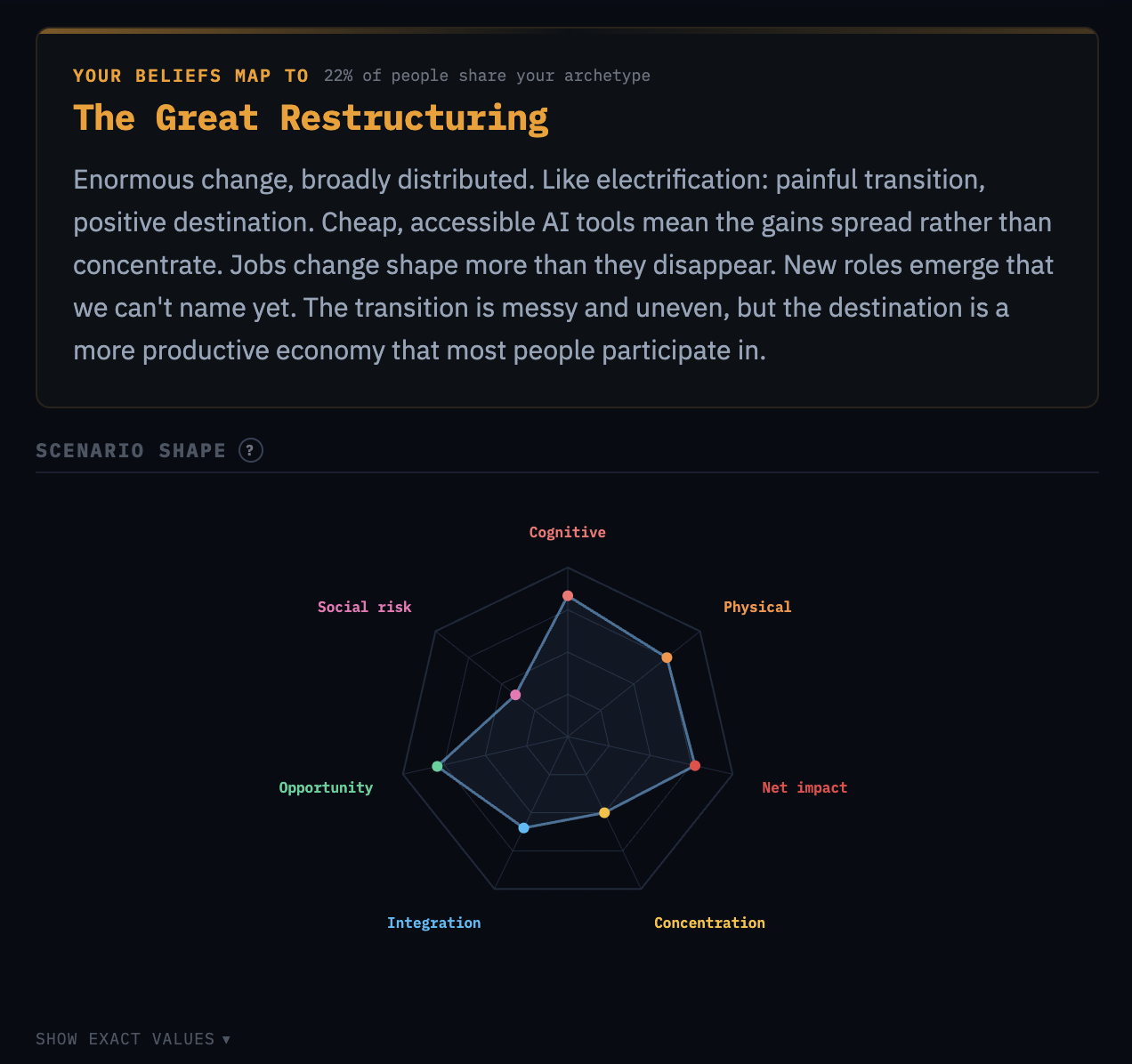
The contradictions are the interesting part
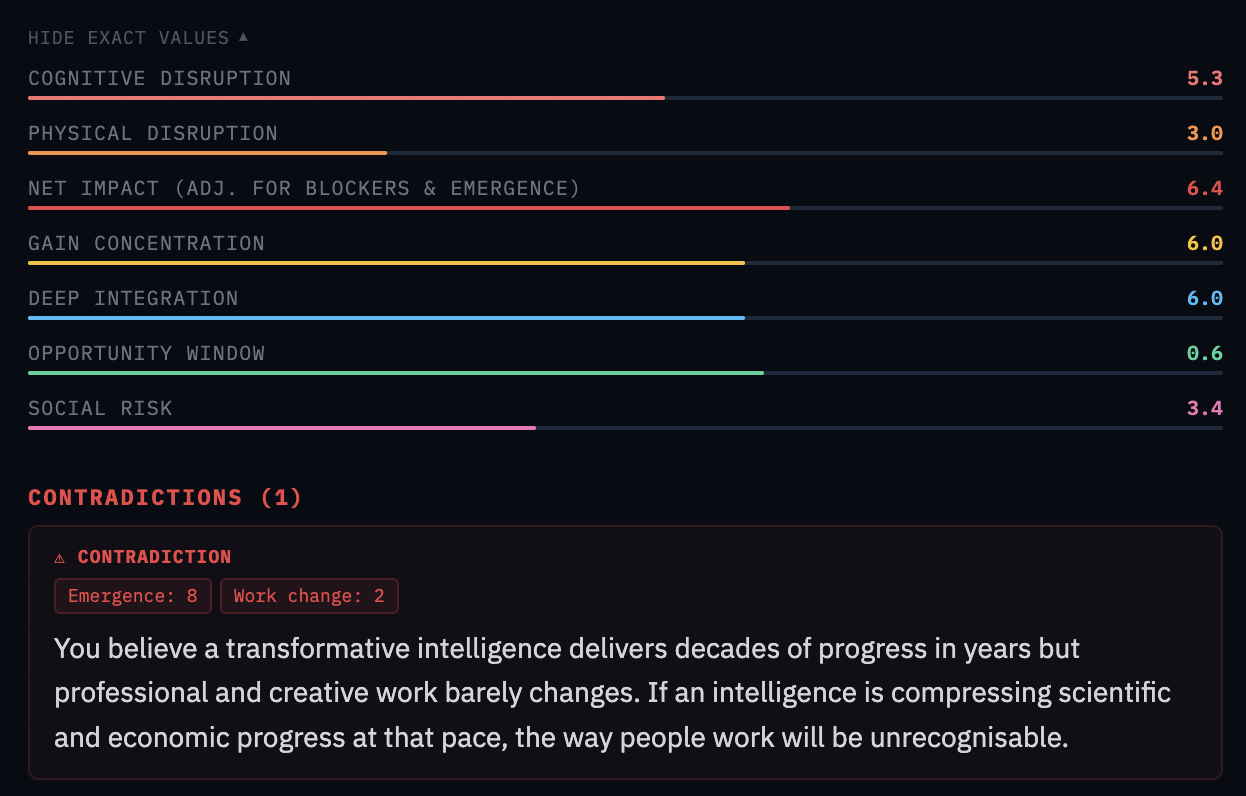
The contradictions and tensions feature only came up when I started building the tool. I started realising what happens when people accidentally hold beliefs that don't sit well together.
For example, if you believe AI is going to be super powerful but have no effect on society and how the world works, those two things are hard to reconcile. Or you might believe AI creates more abundance but also destroys more jobs than it creates. Now, that's actually possible. We don't know how governments and society are going to react. It's not about saying someone is wrong. It's about highlighting that there's a tension between those beliefs, and maybe there's a third thing we don't understand yet.
It's more about giving people a tool to question their own thinking and think through some of this properly.
Worth noting: I'm fully aware there are many more possibilities and many more questions to ask. This is just my interpretation. But it's like a rabbit hole. The deeper you go and the more scenarios you open up, it's infinite. At some point you have to ship something useful.
Making it real for real people
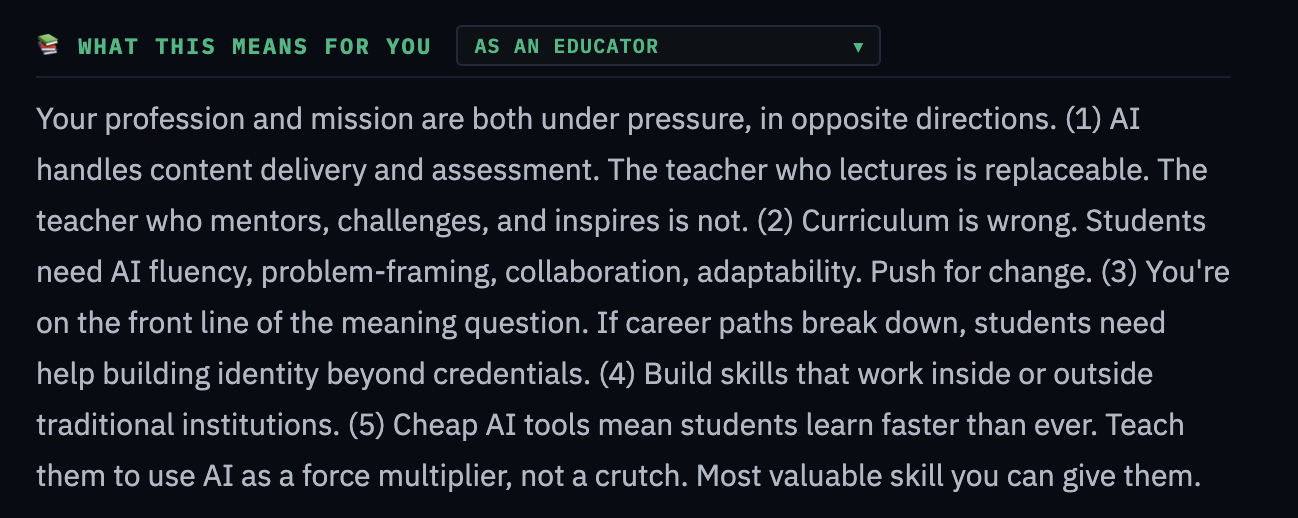
The persona lens was an idea of how to take this somewhat esoteric topic and make it usable and interesting to everyone. At the end of the day, everyone worries about different factors of all the possible outputs and what they mean.
It's impossible to write one archetype that tells you all the outcomes for everyone individually. So I thought: if we have the archetype, then we break it down to what that means for different people within society. What does a particular AI future mean if you're a parent? An investor? A tradesperson? A student? That's more usable and more interesting than one generic summary.
The question nobody wants to ask
I included "meaning crisis" as one of the 14 belief dimensions, and maybe that's one of the things I think about the most.
A lot of people define themselves by what they accomplish, what they achieve, what they overcome. Humanity, in some regards, has defined itself through struggle over time. People feel best when they're making progress, when they're moving forward. I think that's something that separates us from all the other animals on Earth. It's got us to where we are today.
If that sense of achieving is taken away from people, that would be a very different world. But conversely, right now AI seems to be an accelerator. It actually enables us to do more, to achieve more. Things that weren't possible are now possible. The other side of the coin is that it may actually give more of that to more people, which would be amazing.
More questions, not better answers
What surprised me most about building this? I don't think I came out with any better answers. I just have more questions. One thing I do believe though: things are going to be different. That's about all I'm 100% on.
And honestly, I think that's the takeaway for everyone: don't feel bad if you don't have all the answers. Nobody does. Look at the markets, look at investors, politicians, business leaders, the tech leaders themselves. No one actually 100% knows what happens next.
Because we're talking about human conditions here, even though we're talking about artificial intelligence. How is that intelligence going to impact the lives of humans all over the globe? There's nothing more complex than a human, so trying to understand the levers and the outcomes when humans and society are involved is quite possibly as difficult a problem as you could ever have.
If you don't know, don't worry. No one else does.
Take the AI Futures Assessment
14 questions. No right answers. See which of 13 archetypes matches your beliefs about AI, and what those beliefs actually imply for your life.
Map Your Beliefs →